Proper chemical storage is a fundamental part of safe chemical management in the workplace. Whether you work in industry, a laboratory or any other chemical-intensive environment, correct handling and storage are essential to protect both people and the environment. In addition, proper chemical storage plays a key role in meeting legal requirements and reducing the risk of accidents and incidents.
In this article, you’ll find five practical tips to help ensure your chemicals are stored correctly.
Why Is Proper Chemical Storage Important?
Incorrect chemical storage can lead to serious consequences such as dangerous reactions, fires, health problems or environmental releases. Certain chemicals can react with one another, causing explosions or the formation of toxic gases. Poor labelling or inadequate ventilation can expose staff to unnecessary risks. This is why it is vital to follow regulations, maintain robust safety procedures and use appropriate equipment to prevent accidents and ensure a safe working environment.

Five Tips Safe Chemical Storage
Below are five practical tips for safe and compliant chemical storage:
1. Use the Safety Data Sheet as your guide
The Safety Data Sheet (SDS) is a key resource for ensuring safe handling and storage of chemicals. Section 7 (Handling and Storage) provides information on how the substance should be stored, while Section 10 (Stability and Reactivity) specifies which substances it must not be mixed or stored with. For every product, you should review these sections to ensure that your chemical storage practices are correct and compliant.

2. Check the labelling – on both containers and storage areas
The CLP Regulation is EU legislation governing the classification, labelling and packaging of chemical substances and mixtures. This means that all containers and packaging holding hazardous chemicals must be labelled correctly so that users can identify both the contents and the associated hazards.
Under the CLP Regulation, labels must be present:
Directly on the chemical container (bottle, canister, drum, etc.)
On the storage area (e.g., shelves or cabinets)
On the door to the room where chemicals are stored
All areas where CLP-labelled chemicals are handled must be clearly marked with the relevant hazard pictograms. This is essential both for legal compliance and for quickly identifying potential risks.
By always understanding what the various hazard pictograms and labels mean, you can more easily ensure that all products are stored correctly. For example, products marked as flammable must be kept cool and protected from sunlight, while oxidising substances must be stored separately from heat sources and flammable liquids.
3. Avoid incompatible storage (dangerous combinations)
As mentioned in point two regarding product labelling, certain chemicals must not be stored together because they may react dangerously with one another. Section 10 of the Safety Data Sheet provides information on which combinations should be avoided.
A few important examples include:
Flammable liquids must not be stored with flammable gases or easily ignited materials.
Acids must be kept separate from bases.
Oxidising substances must not be stored together with oxidisable materials.
By checking for incompatible storage, you reduce the risk of incidents and injuries — which is ultimately the purpose of having safe chemical storage practices in your workplace.
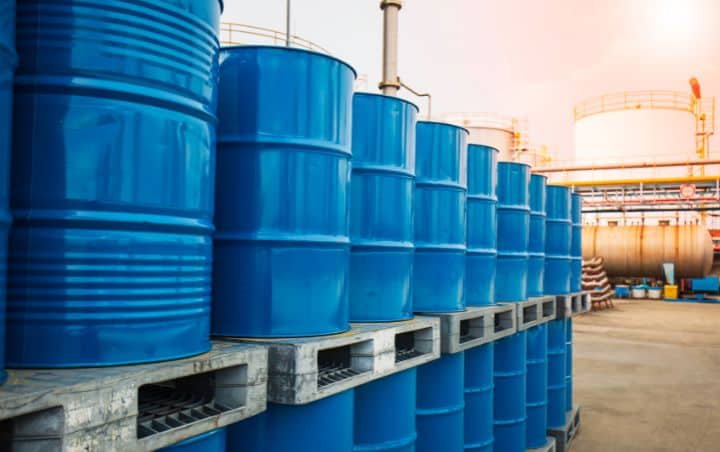
4. Ensure the storage area is properly designed
Secondary containment
You may have come across the term secondary containment in relation to chemical storage. Secondary containment means that the storage area must be equipped with a sealed barrier that prevents any leakage from spreading beyond the designated area. This barrier may be, for example, a raised lip or bund made of plastic or concrete.
Secondary containment is particularly important when handling hazardous substances or when there is a risk that spills could reach floor drains, sewage systems, waterways or soil. It is not only a safety measure, it is also a legal requirement in many situations, especially when storing larger quantities of chemicals or substances with hazardous environmental properties.
A properly designed chemical storage area should:
Have secondary containment if there is a risk of spills or if a floor drain is nearby.
Be well ventilated.
Have a sealed, chemically resistant floor.
Be lockable when storing poisons and CMR substances.
5. Don’t forget about chemical waste storage
If your organisation stores hazardous waste, there are also specific requirements for how this must be done. You should check that:
Waste containers are clearly labelled with the correct contents.
Containers are suitable for the type of waste (e.g., correct material, leakage resistance).
Areas used for hazardous waste storage are clearly signposted and kept separate from other chemical storage.
Following these requirements helps prevent waste from being mixed with other substances, something that can be both dangerous and unlawful.
Summary – Checklist for Safe Chemical Storage
To ensure safe and legally compliant chemical storage, you should always:
Check the Safety Data Sheet for correct handling and storage instructions.
Ensure proper labelling on both containers and storage areas.
Avoid incompatible storage by separating substances that must not be stored together.
Assess the design of the storage area, including ventilation and secondary containment.
Review how chemical waste is stored – correct labelling, suitable containers and proper segregation.
Proper chemical storage not only protects your workplace and the environment, it also ensures compliance with legal requirements and reduces the risk of costly incidents and damage.
Do you have any questions? We are here!
Our EHS consultants have extensive experience in chemical storage and inventory and are here to help you enhance safety and comply with legal requirements. We also offer training in environmental and workplace legislation, REACH, chemical management, and risk assessment.
Do you have any questions? Don’t hesitate to contact us by clicking the button below or emailing us directly at consulting@intersolia.com.