ChatGPT sade:
In April 2024, the European Parliament adopted an amendment to the CLP Regulation, which governs the classification, labelling and packaging of substances and mixtures within the EU. The changes are extensive and are expected to affect many companies that manufacture, import or distribute chemicals.
The purpose of the amendment is to simplify labelling rules and make it easier for consumers to understand the inherent risks associated with chemical products.
New Requirements for Hazard Labels
One of the most visible changes is the new requirements for label design. The actual information on the label does not change, but the CLP Regulation now introduces specific design requirements. These are intended to ensure readability and include rules on colour use, line and letter spacing, font type, and minimum text size.
Pay particular attention to the requirement that mandatory hazard information must now be printed in black on a white background, making many of today’s colourful labels non-compliant.
The amendment also sets rules for when a hazard label must be updated following changes. The deadline depends on whether the updated classification becomes more or less severe. If a change results in a more severe classification, the label must be updated within six months. If the classification becomes less severe, companies have 18 months to implement the update. Labels may also need to be revised if a substance receives a harmonised classification — in such cases, the label must be updated before the deadline set in the CLP Regulation for that specific substance.

A new feature introduced in the revised CLP rules is the option to use fold-out labels. Previously, these were only permitted for very small containers, but the updated regulation expands their use to situations where information needs to be provided in multiple languages. This allows suppliers to print one fold-out label for several markets instead of producing separate labels for each country where the product is sold.
Another new option is the use of digital labels. A digital label can include additional information beyond what appears on the physical label, such as a QR code linking to the Safety Data Sheet (SDS). At present, digital labels may only be used to provide supplementary information — they cannot replace the physical label.
Rules for Advertising
New requirements are also being introduced for advertising chemical products that carry hazard labelling, both in print and in digital formats. Previously, companies were not obliged to include hazard information in advertisements, but this is now changing. Advertising for substances and mixtures classified as hazardous must include information on hazard pictograms, signal words, hazard statements and EUH phrases. If the advertisement is auditory rather than visual, the hazard pictograms and signal word must be spoken aloud.
Possibility to Use Refill Stations
New rules for refill stations have also been introduced to support suppliers’ efforts to reduce packaging waste. To minimise risks to human health and the environment, certain hazard classifications and properties are prohibited for substances and mixtures intended for use in refill stations. This includes, for example, acute toxicity, CMR properties (carcinogenic, mutagenic and reprotoxic) and PBT properties (persistent, bioaccumulative and toxic).
Additionally, refill stations must be properly labelled and equipped to provide immediate assistance in the event of an incident.
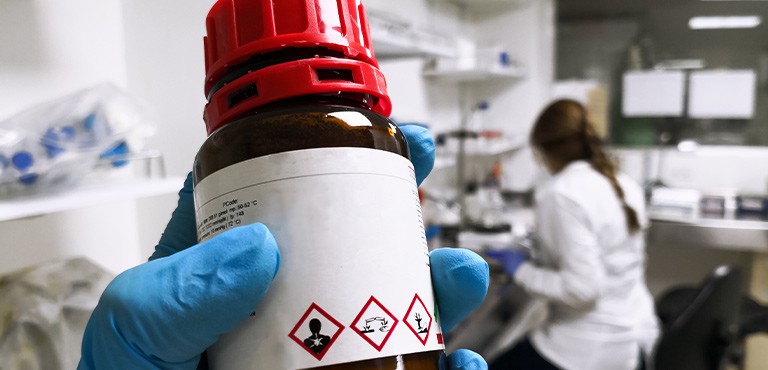
In this article, we take a closer look at the CLP Regulation and how to correctly label your chemical products.
Specific Classification of MOCS
The amendment introduces a new category known as MOCS (More than One Constituent Substances). MOCS covers substances that contain more than one constituent, such as multi-component substances, substances of variable composition, or substances containing identified impurities or additives.
Manufacturers, importers and downstream users must now include all available information on the constituents when classifying physical, health and environmental hazards. The aim is to ensure a more accurate classification by considering information on all components, not just the substance itself. Relevant information may include data on endocrine-disrupting properties, CMR properties, persistence, mobility, bioaccumulation and degradability.
It is important to note that these rules do not apply to chemically unmodified extracts from plants or plant materials. The amendments entered into force on 10 December 2024.
In addition, the new hazard classes for endocrine-disrupting properties and for PBT/PMT properties, introduced in a CLP update in spring 2023, are now also coming into effect.
Do you have any questions? We are here!
Our EHS consultants have extensive experience in safety data sheets and substitution work and are here to help you enhance safety and comply with legal requirements. We also offer training in environmental and workplace legislation, REACH, chemical management, and risk assessment.
Do you have any questions? Don’t hesitate to contact us by clicking the button below or emailing us directly at consulting@intersolia.com.