Companies have a great deal to gain by substituting chemical products that contain undesirable substances. The aim of chemical substitution is to create safer workplaces, reduce environmental impact and support legal compliance. In this article, we outline which products and substances should be phased out, how to identify safer alternatives, and our recommended workflow for managing the substitution process.
What is Chemical Substitution?
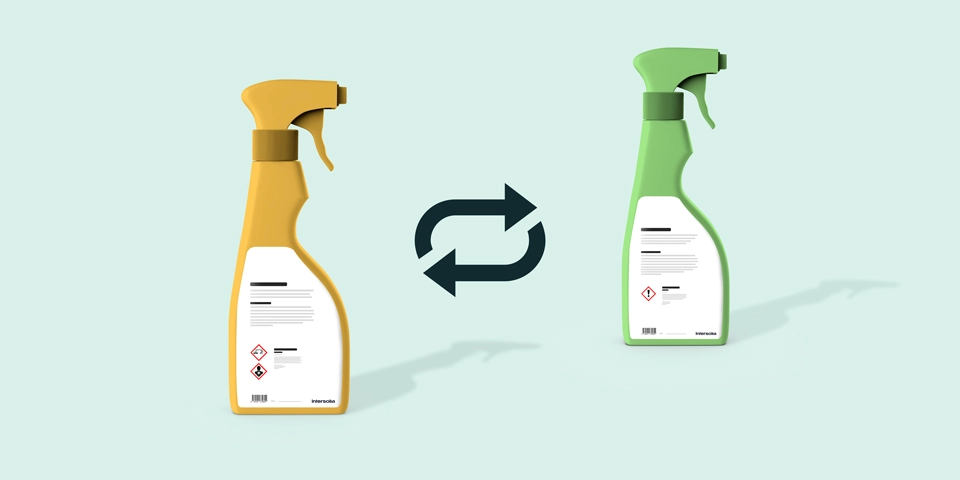
Substituting hazardous substances means replacing chemicals and products with safer alternatives, or using non-chemical solutions, new materials or innovative technologies. The goal of chemical substitution is to reduce or eliminate risks to human health and the environment. A well-implemented chemical substitution process leads to a safer working environment, better consumer protection and reduced environmental impact. It can also strengthen regulatory compliance, support sustainability goals and improve competitiveness through innovation and risk reduction.
To make the chemical substitution process more effective, it’s not only about replacing hazardous chemicals with less harmful alternatives, it’s also about identifying the best possible solutions based on the substance’s function in products and processes.
Utbildning
Substitution av kemiska produkter
En övergripande kurs i hur du kan arbeta med substitution. Vi går igenom vilka lagkrav som gäller, hjälper dig med prioriteringar samt ger praktisk information om vad du bör tänka på. Företag som använder iChemistry får även se hur systemets verktyg för substitution kan användas.
Why Should You Phase Out Chemicals?
A safer and more secure working environment
Phasing out hazardous products, which is what chemical substitution is really about, is a way to eliminate risks at the source. Handling carcinogenic or reprotoxic products or substances can create concern among employees. One way to strengthen the sense of safety in the workplace is to remove or replace these substances or products entirely.
Reduced environmental impact
Some substances do not degrade in the environment, or do so only very slowly, for example heavy metals and perfluorinated organic compounds. Managing these substances has a negative impact on the environment, and by phasing them out you can significantly reduce your overall environmental footprint.
Simplified waste management
Any resulting waste, including packaging, product residues and used absorbents, must be handled appropriately. Waste that can be sorted as combustible, or liquids that can be treated by municipal wastewater facilities, often leads to both a simpler process and cost savings.
Reporting to authorities becomes easier
Authorities may request information on the handling of, for example, phase-out substances and substances listed in the EU Water Framework Directive. If any Candidate List substances are present in the articles you manufacture, you must report them to the European Chemicals Agency (ECHA). Chemical substitution can therefore reduce the amount of reporting required by authorities.
Easier compliance with legal and customer requirements
There is no general ban on handling, for example, carcinogenic products. However, employers must comply with stringent requirements under the Control of Substances Hazardous to Health (COSHH) Regulations, which set out how hazardous substances must be assessed, substituted where possible, and managed to protect workers’ health.
Strengthen your brand and avoid negative publicity
A company that can demonstrate that its products are safe in terms of chemical content gains a significant competitive advantage. Information revealing that goods or products contain undesirable substances can cause considerable damage and undermine the company’s credibility. If you can demonstrate that you actively work with chemical substitution, it can strengthen your public reputation.

Which Products and Substances Should Be Phased Out?
In your chemical substitution work, you can operate on two levels: you can identify undesirable products based on the product’s classification (section 2 of the Safety Data Sheet), or based on the substances it contains (section 3 of the Safety Data Sheet). Both approaches work well.
Method 1: Using the product’s classification
If you want to identify chemical substitution candidates based on product classifications, the following classifications are recommended:
- Carcinogenic, mutagenic and reprotoxic products (CMR products)
Classification: H350, H340, H360 and H362 - Products that may cause respiratory sensitisation
Classification: H334 - Products with acute fatal toxicity
Classification: H300, H310 and H330

iChemistry
Take control with our traffic-light function
You don’t need to be an expert to understand how hazardous a chemical is, the traffic-light function shows it instantly. Your products are assigned a colour based on their properties, giving you a quick and clear indication of their overall hazard level.
Method 2: Using the substances contained in the product
The second approach is to identify undesirable substances within the products. The Swedish Chemicals Agency has created a database containing thousands of substances that meet one or more of these criteria. This list is available directly in iChemistry to support your work.
The recommendation is that the following substances should be completely phased out, regardless of concentration in the finished product:
- Carcinogenic, mutagenic and reprotoxic substances (CMR)
- If the substance is absorbed into the body, it increases the risk of cancer, genetic damage or impaired reproductive ability. Mutagenic substances can damage genetic material, which in turn may lead to other diseases such as cancer. Nearly all substances classified as mutagenic are also classified as carcinogenic.
Classification: H350, H340, H360 and H362
- If the substance is absorbed into the body, it increases the risk of cancer, genetic damage or impaired reproductive ability. Mutagenic substances can damage genetic material, which in turn may lead to other diseases such as cancer. Nearly all substances classified as mutagenic are also classified as carcinogenic.
- Strong respiratory or skin sensitisers
- This includes substances that may cause allergy or asthma symptoms when inhaled, as well as substances that are strong skin sensitisers.
Classification: H334 and H317 Category 1A
- This includes substances that may cause allergy or asthma symptoms when inhaled, as well as substances that are strong skin sensitisers.
- Endocrine-disrupting substances
- These substances adversely affect the hormonal systems of humans or other organisms. Many endocrine disruptors are also classified as reprotoxic. Other harmful effects demonstrated in animal studies include impaired brain development and metabolic diseases such as diabetes.
Classification: EUH380 (human) and EUH430 (environment)
- These substances adversely affect the hormonal systems of humans or other organisms. Many endocrine disruptors are also classified as reprotoxic. Other harmful effects demonstrated in animal studies include impaired brain development and metabolic diseases such as diabetes.
- Mercury, cadmium, lead and their compounds (Hg, Cd and Pb)
- Heavy metals that have severe impacts on both human health and the environment. Because metals do not break down in nature, they can cause long-term negative effects.
- Persistent, bioaccumulative and toxic substances (PBT) and Very persistent and very bioaccumulative substances (vPvB)
- Organic substances that degrade very slowly in the environment and accumulate in biological tissue. Often referred to as “environmental toxins”. Examples include chlorinated, brominated and fluorinated compounds.
Classification: EUH440 (PBT) and EUH441 (vPvB)
- Organic substances that degrade very slowly in the environment and accumulate in biological tissue. Often referred to as “environmental toxins”. Examples include chlorinated, brominated and fluorinated compounds.
- Per- and polyfluoroalkyl substances (PFAS)
- Included because they degrade extremely slowly in the environment. As a precautionary measure, these substances should not be produced or used.
- Additional background: Almost all PFAS substances are either extremely persistent themselves or break down into extremely persistent PFAS compounds in the environment. This is due to the exceptionally strong carbon–fluorine bonds in the molecule. Substances containing only carbon bonded to a single fluorine (-CF-) do not fall under the OECD PFAS definition and are generally more degradable in the environment.
- Fluorinated greenhouse gases
- These are far more potent greenhouse gases compared with carbon dioxide. “Global warming potential” is a measure of how potent the gas is.
- Ozone-depleting substances
- These substances have been almost entirely phased out from society — a true success story.
Classification: H420
- These substances have been almost entirely phased out from society — a true success story.

How Do We Find Better Alternatives?
When you begin reviewing your products, there are several questions you can ask yourselves to determine where to start with your chemical substitution. Consider whether you actually need the product, and whether an existing product with a lower hazard level could be used instead. You can also contact suppliers and industry associations for recommendations. Finally, you can search for alternatives independently.
Three Ways to Substitute Your Chemicals:
Do you actually need a replacement for the product? Could process parameters be modified so that the substance no longer requires a substitute? Is it acceptable for the final product to have slightly different properties?
Substitution using different types of chemicals: In this case, the process or processing conditions usually need to be adjusted (e.g., reaction time or temperature).
Substitution with a similar substance: Note that a similar substance may present similar health and environmental hazards, a potential way of circumventing legislation, so caution is essential.
Places to look for potential alternatives:
Positive product lists
The BASTA register: https://www.bastaonline.se/en
The Nordic Swan Ecolabel: https://www.svanen.se/en/
Good Environmental Choice: List of approved ingredients
RISE lists of hydraulic oils and lubricating greases
Substitution – Examples
SIN-list, Marketplace Alternatives: https://marketplace.chemsec.org/
Recommended Workflow
Step 1 - Identify Products That Should Be Phased Out
Identify products based on their classification and/or the substances they contain and at what concentrations. This also applies to products that must be phased out due to changing legal requirements (for example, substances listed in REACH Annex XIV). Determine the volumes handled and the annual consumption. Prioritise which products should be phased out first based on these factors.
💡 Tip: It is often more difficult to phase out products that are incorporated into the articles you manufacture. It is usually easier to start your chemical substitution by phasing out maintenance products and process chemicals.
The following types of products are undesirable and should be phased out wherever possible:
Carcinogenic, mutagenic and reprotoxic (Classification H340, H350, H360, H362)
May cause allergy or asthma symptoms or respiratory difficulties if inhaled (Classification H334)
Acute fatal toxicity (Classification H300, H310 and H330)
Contain substances on the REACH Candidate List (0.1% or more)*
Contain PBT/vPvB substances (0.1% or more)
Contain perfluorinated substances, PFAS (0.1% or more)
* All substances on the Candidate List are also included in REACH Annex XIV (Authorisation List).
Step 2 - Identify Substitutes
Do we actually need a replacement? Could we, for example, change the method/process or find a technical solution that eliminates the need for the product?
Can we use an existing product that performs better?
Can we use an existing product that is safer from a health and environmental perspective?
Compare the current product with potential alternatives using Safety Data Sheets and technical product data: assess the risks associated with the products (health, environmental and fire hazards), technical performance and cost.
Inform your supplier why you want to phase out the product and request alternatives.
You can also ask whether the substance serves a functional purpose in the product or if it is merely an impurity.
What function does the substance provide, and how would the product’s properties change if it were removed?
Use positive lists to identify substitutes independently.
Contact other suppliers and industry peers.
Compare the current product with the alternatives (HSE properties, technical performance and cost).
Evaluate the product and decide whether to proceed with a chemical substitution.
The Chemical Substitution Process in Summary:
- Define which products you intend to phase out.
- Identify products each year that should be phased out based on:
The criteria and consumption levels
Ill health, accidents or near-misses
Discomfort (for example, strong odour)
- Investigate whether better alternatives exist and document your findings (for example, in risk assessments). Include any chemical substitutions in the environmental report.
- During risk assessments, check whether safer alternatives are available (an investigation and documentation requirement for CMR products).
Do you have any questions about chemical substitution? We are here!
Our EHS consultants have extensive experience in chemical substitution and are here to help you enhance safety and comply with legal requirements. We also offer training in environmental and workplace legislation, REACH, chemical management, and risk assessment.
Do you have any questions? Don’t hesitate to contact us by clicking the button below or emailing us directly at consulting@intersolia.com.