Managing safety data sheets in one market is one thing – doing it across multiple countries is something entirely different. For companies that manufacture, import, or distribute chemical products, this means not only more documentation, but also increased requirements for accuracy, language, updates, and traceability.
Many organisations underestimate the complexity. The result? Manual processes, uncertain version control, and an increased risk of working with outdated or incorrect information.
In this article, we explore what it takes to manage safety data sheets across multiple countries – and how to create a more efficient and compliant process.
What is required for an SDS to be compliant in different countries?
Safety Data Sheets (SDS) are primarily regulated within the EU by the REACH Regulation and the CLP Regulation. However, even though these frameworks are harmonised, it does not mean that a single SDS can be used unchanged across all countries.
Several factors must be considered:
- Language requirements – SDS must be available in the official language(s) of each country where the product is placed on the market
- National requirements – some countries have additional or specific provisions
- Exposure scenarios – may need to be adapted depending on use and local conditions
- Occupational exposure limits (OELs) – vary between countries
This means each market requires careful handling – and that updates can quickly become complex to manage.
Common challenges when updating SDS internationally
In practice, this is where many organisations encounter difficulties – particularly when processes are handled manually or across multiple systems.
Common challenges include:
- Lack of version control – which version is the latest, and is it used everywhere?
- Manual updates – time-consuming and prone to error
- Language management – translations that become inconsistent or outdated
- Limited traceability – difficult to track what has been updated and when
- Unclear processes – responsibilities and workflows are not well defined
The consequence is not only inefficiency, but also an increased risk of non-compliance.
iPublisher
Fast and efficient Safety Data Sheets authoring
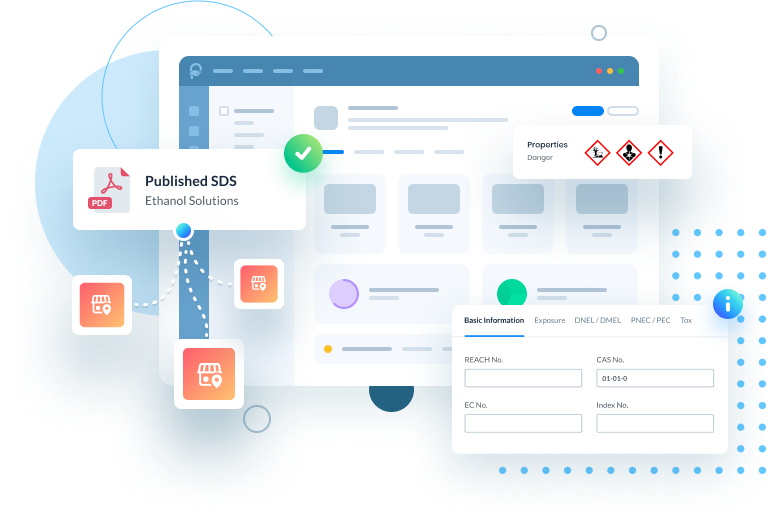
iPublisher is our comprehensive SDS authoring software that enables you to create, publish and distribute Safety Data Sheets. The system gives you full control and supports complete regulatory compliance.
When must a Safety Data Sheet be updated?
A common misconception is that SDS are static documents. In reality, they require continuous updates.
You need to update an SDS when:
- New information about hazardous properties becomes available
- Classification or labelling changes under CLP
- Regulations are updated
- The product composition changes
- Exposure scenarios are revised
Being able to quickly identify and manage these changes is critical – especially when the product is distributed across multiple countries.
How to build an efficient SDS management process across multiple countries
To handle this complexity, organisations need more than ad hoc solutions. A structured and scalable approach is essential.
Key elements include:
Centralised management
Store all information in one system to avoid silos and duplicate versions.
Defined workflows
Establish clear responsibilities, processes, and approval steps.
Version control
Ensure that the correct version is always used – in the right country.
Automated updates
Reduce manual work and minimise the risk of errors.
Efficient distribution
Ensure that the correct SDS reaches the right recipients, in the right format and language.
With the right structure in place, the process becomes not only safer – but also significantly more efficient.

Digital support: How SDS authoring software simplifies the process
Managing safety data sheets manually across multiple countries is rarely sustainable in the long term. That is why more companies are turning to digital solutions to create, update, and distribute SDS.
Modern SDS authoring software enables you to:
- Create and update safety data sheets within a single platform
- Manage multiple languages and markets simultaneously
- Ensure that the correct version is used across all regions
- Automate parts of the update process
- Gain full traceability throughout the entire lifecycle
With a solution like iPublisher, organisations can streamline the entire process – from creation to distribution – while reducing the risk of errors and manual handling.

What to consider when choosing an SDS management system
Not all systems are designed to handle the complexity of multiple markets. When evaluating solutions, you should ensure that the system supports:
- Multiple languages and local regulatory requirements
- Continuous regulatory updates
- Robust version control
- Integration with other systems
- Scalability for future expansion
A system should not only meet your current needs – but also support your organisation as it grows and regulatory demands increase.
Summary
Managing and updating safety data sheets across multiple countries is a complex task that requires structure, control, and compliance.
By working systematically and using digital support, you can:
- Reduce the risk of errors and non-compliance
- Save time in daily operations
- Improve visibility and control
- Ensure that accurate information is always available
iPublisher
Looking to reduce manual work and gain better control over your safety data sheets?
Book a demo of iPublisher and discover how you can create, update, and distribute SDS – across multiple countries, all from a single platform.