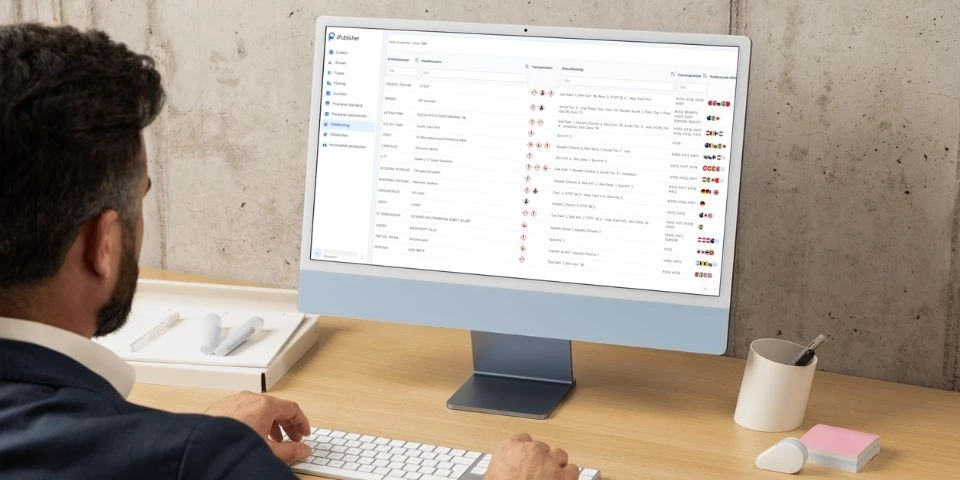
Keeping Safety Data Sheets (SDS) up to date is a central part of a systematic approach to chemical management. At the same time, it is an area that many organisations find challenging.
New suppliers, changes in composition or updates to legislation can quickly affect whether a Safety Data Sheet is still accurate. For EHS professionals, this means an ongoing effort to ensure that the information is correct – and that the requirements under CLP and REACH are met.
In this article, we outline what the regulations mean, the requirements placed on Safety Data Sheets, and how you can take a structured approach to keeping them up to date.
What is the difference between CLP and REACH?
CLP and REACH are two key EU regulations in the field of chemicals. They are closely linked, but serve different purposes.
The REACH Regulation (EC) No 1907/2006 (Registration, Evaluation, Authorisation and Restriction of Chemicals) governs which chemical substances may be used within the EU, how they must be registered and what information must be communicated along the supply chain. REACH also forms the basis for the requirement to provide Safety Data Sheets.
The CLP Regulation (EC) No 1272/2008 (Classification, Labelling and Packaging) regulates how chemicals are classified and labelled. This includes hazard pictograms, hazard statements and how risks must be communicated.
In practice, this means that:
- CLP determines how a product should be classified and labelled
- REACH determines when a Safety Data Sheet is required and what it must contain
What about the UK?
Following Brexit, the UK has implemented its own versions of the EU regulations: UK REACH and GB CLP. These largely mirror the EU frameworks but are managed by the Health and Safety Executive (HSE) and may diverge over time.
For companies operating in both the EU and the UK, this means that requirements for Safety Data Sheets, classifications and registrations may need to be reviewed and maintained separately.
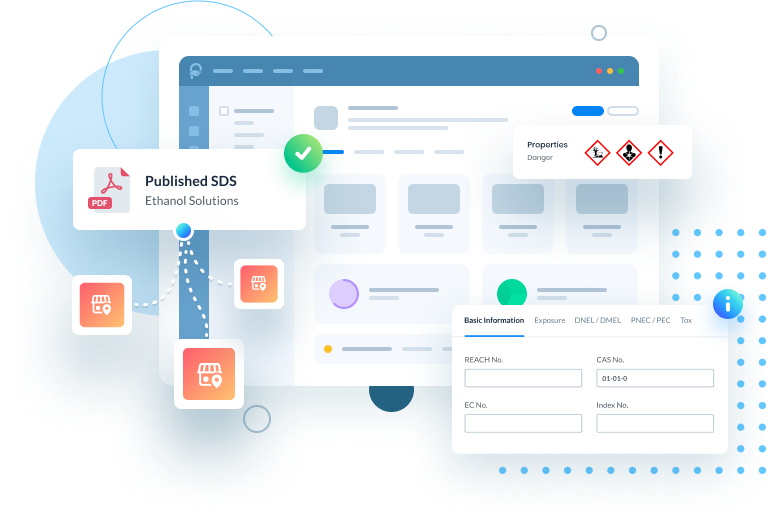
iPublisher
Fast and efficient Safety Data Sheets authoring
iPublisher is our comprehensive SDS authoring software that enables you to create, publish and distribute Safety Data Sheets. The system gives you full control and supports complete regulatory compliance.
What requirements apply to Safety Data Sheets?
Under the REACH Regulation (EC) No 1907/2006, a Safety Data Sheet must contain 16 mandatory sections. However, having the correct structure in place is not enough – the content must also be accurate and up to date.
Some key sections to ensure are:
- Section 2 – Hazards identification
Should reflect the current classification under the CLP Regulation (EC) No 1272/2008, including, for example, CMR properties. - Section 8 – Exposure controls/personal protection
Should include up-to-date occupational exposure limits and protective measures. - Section 15 – Regulatory information
Should include relevant legislation, such as restrictions and authorisation requirements under REACH.
As regulations are continuously updated – for example through new substances added to the Candidate List or revised classifications from the European Chemicals Agency (ECHA) – Safety Data Sheets need to be reviewed regularly.
Common challenges in managing Safety Data Sheets
In many organisations, there are recurring challenges linked to the management of Safety Data Sheets:
Reactive updates
Safety Data Sheets are only updated when a need arises, for example during an audit or in response to a customer request, rather than continuously based on regulatory changes.
Lack of version control
Multiple versions of the same Safety Data Sheet may circulate, making it difficult to ensure that the correct information is being used.
Insufficient monitoring of regulatory changes
Updates to, for example, Annex II of the REACH Regulation or new classifications may go unnoticed, meaning the impact on existing Safety Data Sheets is not identified.

How to keep your Safety Data Sheets up to date
To establish a sustainable approach, the management of Safety Data Sheets needs to be systematic and clearly defined.
A structured way of working may include:
- Maintaining a central register of all chemicals and SDS
This provides visibility and makes follow-up easier. - Ensuring clear version control
It should be clear which version is current and when it was last updated. - Monitoring changes in legislation and classification
For example, through updates from the European Chemicals Agency (ECHA) or other relevant sources. One option is to use Intersolia’s regulatory monitoring service. - Establishing a clear process for updates and distribution
When an SDS is updated, the correct version needs to reach the right recipients, and it should be possible to demonstrate that distribution has taken place.
Working in this way reduces the risk of non-compliance and makes it easier to ensure regulatory compliance.
A more efficient way to manage Safety Data Sheets
As requirements continue to increase, many organisations find that manual ways of working become difficult to maintain over time.
Digital systems can support this work by centralising information, facilitating updates and improving traceability. With the right support in place, it becomes easier to work proactively and ensure that Safety Data Sheets are up to date and accessible where they are needed.
With iPublisher, you can create, update and distribute Safety Data Sheets within a single platform, with built-in support for REACH structure and CLP classification. When a substance is updated, the system flags which SDS are affected. Once an SDS is finalised, it is automatically distributed to customers and internal recipients, with full traceability.
Combined with iChemistry chemical management system, you also gain control over your entire chemical inventory, risk assessments, exposure data and regulatory status in one place.

Summary
Meeting the requirements under CLP and REACH is not just about having Safety Data Sheets in place – it is about ensuring they are accurate, up to date and used correctly within the organisation.
By taking a structured approach, monitoring regulatory changes and establishing clear processes, you can reduce risks and gain better control over your chemical management.
iPublisher
Fast and efficient Safety Data Sheets authoring
iPublisher is our comprehensive SDS authoring software that enables you to create, publish and distribute Safety Data Sheets. The system gives you full control and supports complete regulatory compliance.